01→
Business quality
Growth · margins · profitability
The iPivot Investor Journey
Clearer context. Better questions. More informed private-market decisions.
Structured insights
Clearer issuer and investment context.
Greater transparency
Risk-aware education and disclosure.
Built for investors
Individual and institutional perspectives.
Investor journey
Explore opportunities and understand context.
Access structured information and disclosures.
Read risks, valuation context and key questions.
Make an independent decision with appropriate advice.
A disciplined path
Information → context → questions → independent judgement.
Your pathway
Four disciplined stages from discovery to independent decision-making.
01
02
03
04
Learn before you invest
Choose where you want to start.
Learn before participating · Start with risk education. →
How iPivot Evaluates Issuers
A structured, evidence-led assessment across the factors that matter to investors. The assessment is sector- and stage-aware. Not every metric applies to every company, and the depth and emphasis may vary by sector and stage.
Growth · margins · profitability
Liquidity · balance sheet · runway
CAC · LTV · payback · sector metrics
Leadership · UBOs · controls
Benchmarks · dilution · terms
Downside · proceeds · milestones
Sector-specific perspective
Different business models require different evidence, metrics and risk questions.
The examples shown are illustrative. Review scope may expand or narrow depending on the issuer, sector, stage and information available.
How opportunities are screened
Why investors should care
The sequence below is an issuer-screening and disclosure process — not an investor action list. It shows the gates an opportunity may pass through before and after campaign approval.
01
Initial submission and suitability assessment.
02
Preliminary review and key information analysis.
03
Detailed evaluation of financials and business model.
04
Independent review and decision.
05
Deeper due diligence where required.
06
Final preparation and approvals.
07
Structured information disclosed to investors.
08
Ongoing reporting and performance monitoring.

Illustrative issuer snapshot
Financial, operating, valuation and risk indicators should sit together so investors can scan context before drilling deeper.
Performance
Growth, margins and profitability
Resilience
Runway, debt and concentration
Terms & risk
Valuation, use of funds and downside
Illustrative example · Growth-stage technology company
Revenue trend
EBITDA
01S$2.1M
Illustrative operating profit
Gross Margin
0268%
Illustrative margin
Cash Runway
0318 months
Illustrative runway
Debt
04S$1.2M
Illustrative total debt
Recurring Revenue
0572%
Illustrative revenue mix
Customer Concentration
0618%
Illustrative top-5 share
Valuation context
Presented as context, not a recommendation or fairness opinion.
Use of funds
45% Product
30% Expansion
15% Working capital
10% Other
Key investment considerations
Why this matters to investors
Supports stronger issuer screening and transparency.
Helps investors see material differences more easily.
Investor decisions and risk tolerance remain personal.
iPivot's assessment is intended to support better disclosure, stronger issuer screening and more informed investor decision-making. Investors should still conduct their own assessment and consider their own risk tolerance before investing. Admission to the platform, completion of review or campaign approval does not constitute a recommendation, guarantee of investment performance, guarantee of returns or regulatory approval of an issuer.

Investor Knowledge Centre
Practical guides, frameworks and process visuals designed to be read, reviewed and revisited — not treated as decoration.
Investor guide 01
A clear visual primer on the risks that matter before committing capital.
Capital loss is possible
Liquidity can be limited
Valuations can change
Exit timing is uncertain
Investor guide 02
A practical review checklist to help investors interrogate an opportunity more intelligently.
Business model and economics
Management and governance
Valuation and terms
Key risks and dependencies
Investor guide 03
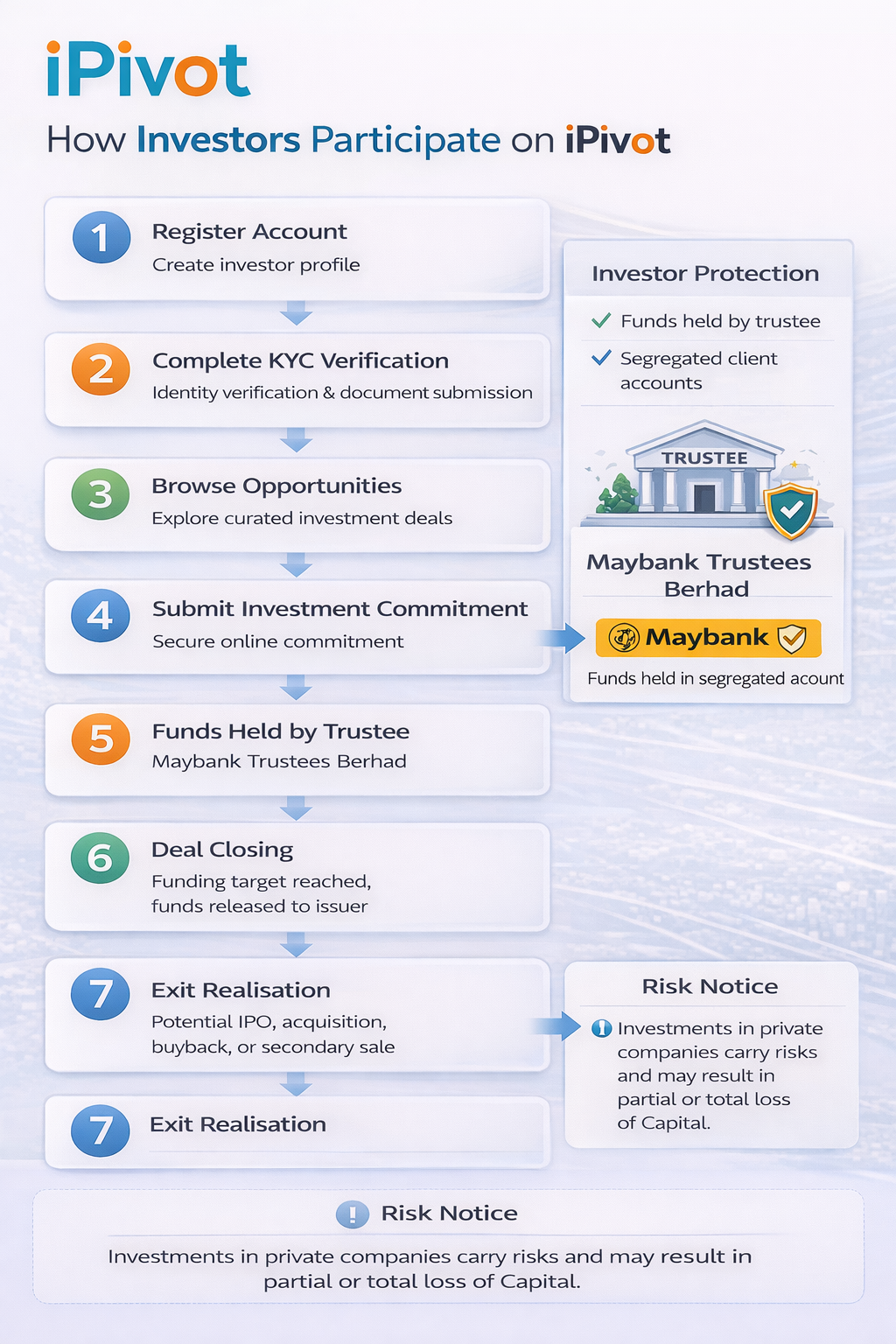
A step-by-step view of what happens from account setup through investment participation and post-investment context.
Registration and verification
Opportunity review
Commitment and funding
Ongoing investor context
Framework 01
A structured view of how opportunities move through evidence gathering, review and decision checkpoints.
Defined review stages
Clear evidence gates
Independent decision points
Controlled progression
Framework 02
A visual map of who is responsible for what across issuer, platform, advisers and investor roles.
Clear role boundaries
Defined accountability
Transparent responsibilities
Better investor understanding
Participation controls
A simple verification sequence before participation.
Understand verification →Verify your identity.
Confirm you are real.
Regulatory and risk checks.
Verification is being prepared and is not currently accepting information. Requirements may vary depending on the investor and applicable controls.
Investor Enquiry
No live campaigns are currently available. Register for future opportunity updates.
Read the risk disclosure and seek independent advice before making investment decisions.